Miserable. That one word pretty much summarizes 1941's winner How Green Was My Valley. The film (based on a novel) is set in a Welsh mining town that loses its greenness in both the literal and figurative sense. Gone are the lush hillsides, and gone is the simplicity of life. The entire story is a flashback through the memories of Huw, who in the film is the youngest boy in a family of six sons and one daughter. The family suffers loss through mining disasters and moving to America. Although the daughter (played by Maureen O'Hara) marries well, she does not marry happily. She is in love with the minister, who nobly refuses to marry her because he doesn't want to see her live in poverty. Instead, she has a posh life she hates. How noble indeed.
I intended to just watch half of the film tonight, but I decided that if I stopped it, I wouldn't finish it. So I finished it. At just under two hours, it shouldn't have been that bad, but in ways, it was because just when I thought things couldn't get worse, they did.
The actual film was quite stunning to watch. The long shots capture how the coal mine shapes the town, and the actors' facials expressions are captured in close shots. The actors were convincing in their roles. It's just that the story itself was lacking for me. I wouldn't watch this one again, and I definitely don't recommend it.
Monday, July 28, 2014

Sunday, July 27, 2014
Rebecca: 1940
From what little I knew about this film, I expected a romance, and while it didn't disappoint me, the film was actually more suspenseful than romantic. Rebecca is about a young woman who falls in love with Mr. DeWinter, a widower whose dead wife was the famous Rebecca. After marrying Mr. DeWinter, the new Mrs. DeWinter returns to his estate Manderley in Cornwall, England, with him, and she experiences firsthand how much his dead wife's memory is kept alive by the creepy housekeeper Mrs. Danvers. No matter where the new Mrs. DeWinter turns, there is something that relates to Rebecca, from the embroidered linens to the letters in the desk to the closed off west wing where Rebecca had her room. And Mrs. Danvers makes sure to keep the new Mrs. DeWinter as uncomfortable as possible with frequent references to the amazing first Mrs. DeWinter.
The film was directed by Hitchcock, and his use of lighting and close-up shots added to the suspense and intensity of each scene. As the film progressed, he increased the close-ups of Mrs. Danvers's face, and with only part of her face illuminated and the other part in a dark shadow, she is indeed sinister (see below).
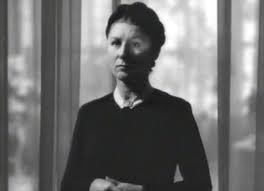
The new Mrs. DeWinter's fear of her housekeeper is fully understandable, especially after Mrs. Danvers takes her into the west wing and shows her true obsession over Rebecca through her tour. Towards the end of the film, I realized it might have been a mistake to watch the film at night. Although it isn't an outright scary film, the character Mrs. Danvers is incredibly creepy.
One particularly odd aspect of this film for me was how we never find out the first name of the new wife. It's like she doesn't really matter (even though Maxim DeWinters loves her) when compared to Rebecca. Her name and her identity are insignificant in comparison. I wonder if the same is true in the novel, as the film is based on Daphne DuMaurier's novel with the same title.
Something else interesting was that this film was produced by David Selznick, who also produced Gone With the Wind. Other than both films being adaptations of novels, not much else is similar between the two. The female leads are vastly different, with the second Mrs. DeWinters being quite subdued and kind whereas Scarlet is demanding and so selfish it's almost evil. Having the Oscar for Best Picture two years in the row is impressive, and I'm curious to know what else Selznick produced.
The film was directed by Hitchcock, and his use of lighting and close-up shots added to the suspense and intensity of each scene. As the film progressed, he increased the close-ups of Mrs. Danvers's face, and with only part of her face illuminated and the other part in a dark shadow, she is indeed sinister (see below).
The new Mrs. DeWinter's fear of her housekeeper is fully understandable, especially after Mrs. Danvers takes her into the west wing and shows her true obsession over Rebecca through her tour. Towards the end of the film, I realized it might have been a mistake to watch the film at night. Although it isn't an outright scary film, the character Mrs. Danvers is incredibly creepy.
One particularly odd aspect of this film for me was how we never find out the first name of the new wife. It's like she doesn't really matter (even though Maxim DeWinters loves her) when compared to Rebecca. Her name and her identity are insignificant in comparison. I wonder if the same is true in the novel, as the film is based on Daphne DuMaurier's novel with the same title.
Something else interesting was that this film was produced by David Selznick, who also produced Gone With the Wind. Other than both films being adaptations of novels, not much else is similar between the two. The female leads are vastly different, with the second Mrs. DeWinters being quite subdued and kind whereas Scarlet is demanding and so selfish it's almost evil. Having the Oscar for Best Picture two years in the row is impressive, and I'm curious to know what else Selznick produced.
Saturday, July 26, 2014
Gone With the Wind: 1939
Where do I begin with this film...it's an epic at nearly four hours long, a classic film frequently spoofed or quoted, and a story about one woman who defines selfishness for most of her life. Other than knowing a few of the famous lines and a couple plot points, I didn't really know Scarlet O'Hara's story, and the film really is just that it: her story. Clark Gable as Rhett Butler is certainly part of the film, but it isn't Rhett's story: Rhett is only involved when he's connected to Scarlet. Whatever I was expecting, it wasn't a story so focused on her, especially since she, in many ways, is an incredibly unlikable character.
Vivien Leigh portrayed Scarlet, and although I haven't seen her in anything else, she truly captures Scarlet's flirtatious, deceptive, selfish, determined nature. For most of her life, Scarlet believes she is in love with her childhood sweetheart, Ashley Wilkes, and when he marries Melanie, a woman who actually likes Scarlet, the world seems to end for Scarlet. She ends up marrying Melanie's brother Charles, and we learn later in the film that she only does this to make Ashley jealous (and, of course, that doesn't work). This marriage is one of three for Scarlet, and while marrying Charles does take him away from another woman, the marriage doesn't seem as despicable as her second when she takes her sister's love and marries him to get the money to save her beloved home Tara.
Being set during and after the Civil War in Georgia, I gained a new perspective of a war that I learned about in school. I knew the war crushed the South, but in Gone With the Wind, I actually saw that devastation, including the burning of Atlanta, the destruction of land, and the dead and wounded soldiers. One particular tragic scene is when Scarlet, Prissy, Melanie, and Melanie's baby are in a wagon trying to get to Tara. All they can see are dead soldiers littering the fields, and in some areas, they must go over the bodies on the road. This image showed just how much death this war brought, and the looks on the characters' faces shows that seeing these fields makes them realize just how terrible the war was. But the only ones who seem to realize that the war should never have been fought is Scarlet (because it ruined her life), Rhett (because he knew they would lose), and Ashley (because he now sees what happened). The other characters in the war continue to blame the Yankees, even more so when the carpetbaggers arrive and set up camp, making life even more difficult.
Would I spend another four hours to watch this film again? No. I enjoyed watching the first disc (yes, it was on two DVDs), but about halfway through the second, I'd had enough of Scarlet. The film itself (the first film in color to win an Oscar) was gorgeous, the soundtrack was perfect, but Scarlet grows more and more selfish until the very end, and even then, I'm not sure she redeems herself. I do wonder if Scarlet even did win Rhett back. The film ends with her claiming that she will, and considering how the first of the film went, she usually gets what she wants. But Rhett has always been different, which makes me think this may be the time in her life when she truly learns what it means to be unhappy.
Vivien Leigh portrayed Scarlet, and although I haven't seen her in anything else, she truly captures Scarlet's flirtatious, deceptive, selfish, determined nature. For most of her life, Scarlet believes she is in love with her childhood sweetheart, Ashley Wilkes, and when he marries Melanie, a woman who actually likes Scarlet, the world seems to end for Scarlet. She ends up marrying Melanie's brother Charles, and we learn later in the film that she only does this to make Ashley jealous (and, of course, that doesn't work). This marriage is one of three for Scarlet, and while marrying Charles does take him away from another woman, the marriage doesn't seem as despicable as her second when she takes her sister's love and marries him to get the money to save her beloved home Tara.
Being set during and after the Civil War in Georgia, I gained a new perspective of a war that I learned about in school. I knew the war crushed the South, but in Gone With the Wind, I actually saw that devastation, including the burning of Atlanta, the destruction of land, and the dead and wounded soldiers. One particular tragic scene is when Scarlet, Prissy, Melanie, and Melanie's baby are in a wagon trying to get to Tara. All they can see are dead soldiers littering the fields, and in some areas, they must go over the bodies on the road. This image showed just how much death this war brought, and the looks on the characters' faces shows that seeing these fields makes them realize just how terrible the war was. But the only ones who seem to realize that the war should never have been fought is Scarlet (because it ruined her life), Rhett (because he knew they would lose), and Ashley (because he now sees what happened). The other characters in the war continue to blame the Yankees, even more so when the carpetbaggers arrive and set up camp, making life even more difficult.
Would I spend another four hours to watch this film again? No. I enjoyed watching the first disc (yes, it was on two DVDs), but about halfway through the second, I'd had enough of Scarlet. The film itself (the first film in color to win an Oscar) was gorgeous, the soundtrack was perfect, but Scarlet grows more and more selfish until the very end, and even then, I'm not sure she redeems herself. I do wonder if Scarlet even did win Rhett back. The film ends with her claiming that she will, and considering how the first of the film went, she usually gets what she wants. But Rhett has always been different, which makes me think this may be the time in her life when she truly learns what it means to be unhappy.
Saturday, July 12, 2014
You Can't Take It With You: 1938
Frank Capra's You Can't Take It With You is a fun comedy with a moral: life is about friendship and family, not money. And in watching the film, I had the sense that this concept is one that Capra fully embraces on film and in real life. The actors seemed so natural in their roles, and the story (originally a play) was heartwarming and humorous, but not cheesy. It seemed like I had a window into these characters' lives, that's how real they seemed to me.
Jimmy Stewart plays the role of Tony Kirby, a wealthy businessman's son who is being groomed to take over the family bank. Stewart falls for Alice (played by Jean Arthur), his secretary and granddaughter of Grandpa Vanderhoff, the one man who refuses to sell his home to allow Kirby's father's deal to go through. Obviously, this creates some tension between the families, but most of the tension is generated by Tony's snooty mother and money-driven father. Vanderhoff doesn't let much bother him. He explains to Tony's father how he used to be a businessman himself until one day he realized just how unhappy he was. That day he got on the elevator, took it the ground level, and left the building, never to return to work, and ever since that day, he has been much happier. Of all the characters, Grandpa epitomizes the theme of the film; he is rich in friends and family, thus he is happy, whereas Tony's father, the elder Kirby, has money but no real happiness.
As much as I enjoyed the film, it did occur to me that whenever I see Jimmy Stewart, he seems to the play a similar character, the "aww shucks" character. Then again, I've only seen him in his most famous early rolls as George Bailey and Mr. Smith. I've seen clips of him in the later Hitchcock films, so perhaps when I'm done with the best pictures, I should move on to films that show a different side to actors that seem to have only one character in them. (Don't get me wrong...I love Jimmy Stewart as these characters...he seems genuine in each role).
The best part about You Can't Take It With You was the message. I love how this film shows (in several situations) how the real "rich men" of the world are the ones who make connections with others and care for others. Whenever Grandpa is in need of help, his friends and family are there. Sometimes we need a reminder of this, and You Can't Take It With You is a perfect reminder that will also make you laugh.
Jimmy Stewart plays the role of Tony Kirby, a wealthy businessman's son who is being groomed to take over the family bank. Stewart falls for Alice (played by Jean Arthur), his secretary and granddaughter of Grandpa Vanderhoff, the one man who refuses to sell his home to allow Kirby's father's deal to go through. Obviously, this creates some tension between the families, but most of the tension is generated by Tony's snooty mother and money-driven father. Vanderhoff doesn't let much bother him. He explains to Tony's father how he used to be a businessman himself until one day he realized just how unhappy he was. That day he got on the elevator, took it the ground level, and left the building, never to return to work, and ever since that day, he has been much happier. Of all the characters, Grandpa epitomizes the theme of the film; he is rich in friends and family, thus he is happy, whereas Tony's father, the elder Kirby, has money but no real happiness.
As much as I enjoyed the film, it did occur to me that whenever I see Jimmy Stewart, he seems to the play a similar character, the "aww shucks" character. Then again, I've only seen him in his most famous early rolls as George Bailey and Mr. Smith. I've seen clips of him in the later Hitchcock films, so perhaps when I'm done with the best pictures, I should move on to films that show a different side to actors that seem to have only one character in them. (Don't get me wrong...I love Jimmy Stewart as these characters...he seems genuine in each role).
The best part about You Can't Take It With You was the message. I love how this film shows (in several situations) how the real "rich men" of the world are the ones who make connections with others and care for others. Whenever Grandpa is in need of help, his friends and family are there. Sometimes we need a reminder of this, and You Can't Take It With You is a perfect reminder that will also make you laugh.
Subscribe to:
Posts (Atom)